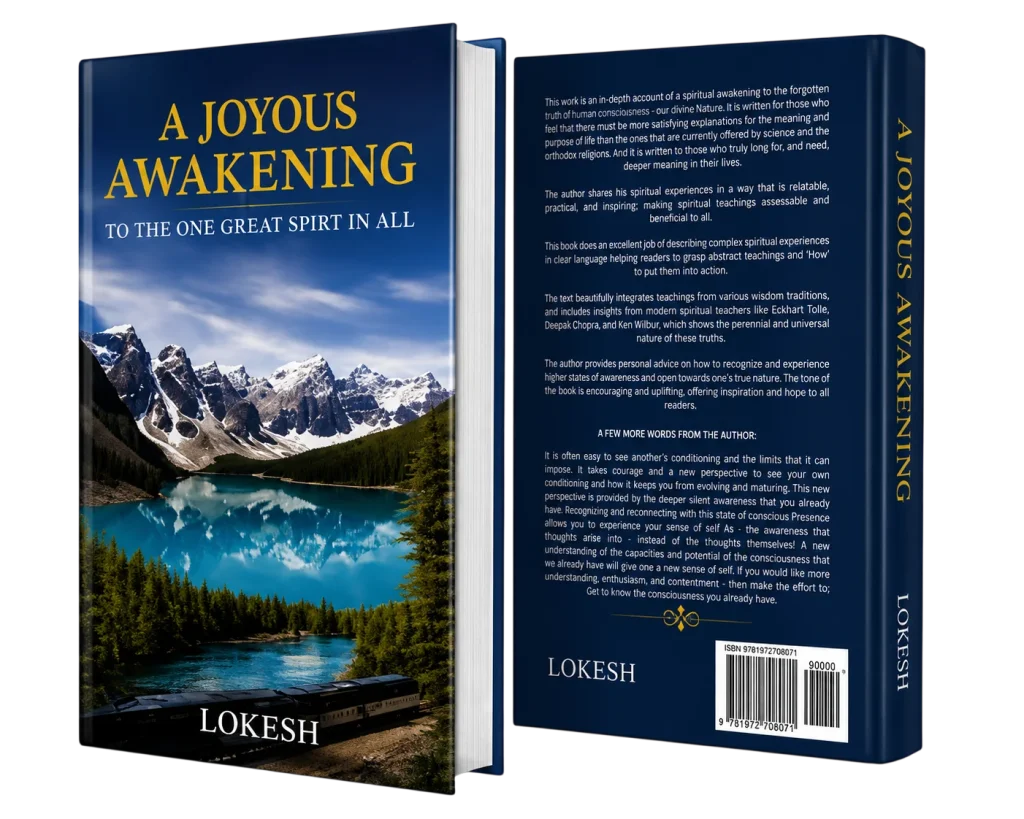

Some books arrive when life feels settled. Others seem made for the moment when familiar answers stop working.
For Serious Spiritual Seekers, that second kind often matters more. A Joyous Awakening by LOKESH begins from that restless place.
The book does not introduce spirituality as a neat set of ideas. Instead, LOKESH presents a personal search for deeper understanding, greater awareness, and what he describes as direct knowledge of the self.
In the preface, he speaks to readers who feel that outward success or ordinary explanations no longer answer their deeper questions.
The introduction then frames the work as an account of spiritual awakening and expanded states of awareness.
So, from the beginning, you are not standing outside someone else’s philosophy. You are walking beside someone who keeps asking, observing, doubting, learning, and returning to one difficult question:
What does it really mean to know yourself?
Before the language of awakening appears, there is something more familiar: disappointment.
LOKESH begins his story with a painful breakup and the confusion that followed it. Rather than turning that moment into a spiritual shortcut, he shows how emotional pain pushed him toward self-questioning. He examines his reactions, his ideas about love, his ego, and his desire to understand why people behave as they do.
That early honesty gives the book warmth. It also separates A Joyous Awakening from many books about meaning of life that begin with conclusions. Here, the questions arrive first.
Gradually, the search widens. LOKESH studies teachings associated with G. I. Gurdjieff, explores the Sermon on the Mount, and begins thinking more carefully about self-observation. Each new idea grows from an earlier personal need. Instead of jumping from pain to revelation, the book lets curiosity become a bridge.
Once that bridge is crossed, the book becomes deeply interested in attention.
LOKESH describes practices such as self-observation, self-remembering, and the non-expression of negative emotions. What makes these sections engaging is that he does not present the mind as a simple enemy. He watches how quickly it wanders, reacts, judges, remembers, and slips back into habit.
That is where many Serious Spiritual Seekers may recognize themselves.
The book repeatedly returns to the difference between knowing an idea and actually noticing it within your own life. LOKESH describes discovering how conditioned his thoughts can be and how difficult it is to remain present even briefly. Awareness becomes something tested while driving, working, speaking, walking, and dealing with discomfort.
Readers drawn to books about self discovery may especially appreciate this part because the focus is not on inventing a better personality. It is on seeing the existing one more clearly.
The tone changes when LOKESH begins describing what he calls the Transcendent State.
Until then, much of the journey involves discipline, observation, and study. Then the book moves into experiences that LOKESH understands as direct inner knowledge. He describes silence, witness consciousness, presence, and a feeling that knowledge is being experienced rather than merely thought about.
Whether a reader shares his interpretation or not, these sections reveal what the author means by awakening. He is not talking only about feeling calmer. He describes a shift in identity, attention, and the way consciousness itself is experienced.
That is also where A Joyous Awakening becomes an interesting companion to books about consciousness. It moves between memoir, spiritual practice, Christian reflection, esoteric teaching, and personal interpretation without pretending those are exactly the same thing.
Another distinctive part of the book is its conversation with Christianity.
Author LOKESH repeatedly returns to Jesus, the Sermon on the Mount, the Kingdom of Heaven, rebirth, faith, and inner transformation. Yet he reads these ideas through a wider spiritual lens shaped by Gurdjieff, esoteric Christianity, yoga, mystical traditions, and other wisdom teachings.
This creates one of the book’s most thoughtful tensions. The author is not simply rejecting the tradition he grew up with. Instead, he asks whether familiar religious language may contain meanings that become clearer through inner practice.
For example, his discussion of “the Kingdom of Heaven is within you” becomes part of a larger reflection on consciousness and inner change. Likewise, rebirth is explored as spiritual transformation rather than only doctrine. The result keeps asking readers to look beneath inherited language and notice what it might mean in lived experience.
For readers exploring books about finding meaning in life, this approach can feel refreshing because faith and inquiry remain in the same room.
A Joyous Awakening is not built around one dramatic moment and then finished.
Its later structure continues into “Shaktipat Awakening: Phase Two” and then broadens into teachings on witness consciousness, meditation, the SELF, the mind, the ego, the spiritual master, and initiation. That wider architecture matters because LOKESH presents awakening as the beginning of a longer process of understanding.
The rhythm changes, too. Early chapters are personal and narrative. Later sections become more reflective and instructional. You can therefore move through the book in two ways: as one person’s spiritual search, and as a set of themes to revisit slowly.
In that sense, the book invites rereading rather than rushing.
The strongest connection comes from the book’s refusal to pretend that seeking is always graceful.
There is confusion, longing, discipline, wonder, contradiction, and repeated self-questioning. LOKESH does not present his path as a polished sequence of perfect insights. He shows how often understanding arrives beside ordinary life.
You may connect with the book if you:
That emotional honesty gives A Joyous Awakening its quiet pull. It does not demand that every reader interpret each experience the same way. Instead, it offers one person’s sustained attempt to understand consciousness, identity, faith, and inner freedom.
Perhaps that is why the book can stay with Serious Spiritual Seekers after the final page. It keeps returning you to your own questions.
Not “What should I believe?”
But something gentler, and harder to avoid:
“What am I actually seeing within myself?”
If surface-level answers no longer satisfy you, this book offers a personal exploration of awareness, faith, and inner change, giving deeper questions room to breathe, unfold, and matter for you.
LOKESH avoids quick spiritual formulas. He combines memoir, self-observation, mystical experience, Christian reflection, and esoteric teachings, giving readers a lived journey with ideas worth revisiting slowly and personally over time.
Yes. The book explores self-observation, self-remembering, attention, meditation, witness consciousness, and inner transformation, showing how these practices meet ordinary work, travel, relationships, personal struggle, and lasting change in daily life.
Yes, especially for readers open to contemplative interpretation. LOKESH returns to Jesus, the Sermon on the Mount, faith, rebirth, and the Kingdom of Heaven through an experiential spiritual lens today.
Choose it when you want spiritual reading that goes beyond comfort. Its questions, practices, and personal reflections can encourage deeper self-inquiry long after you reach the final page and beyond.