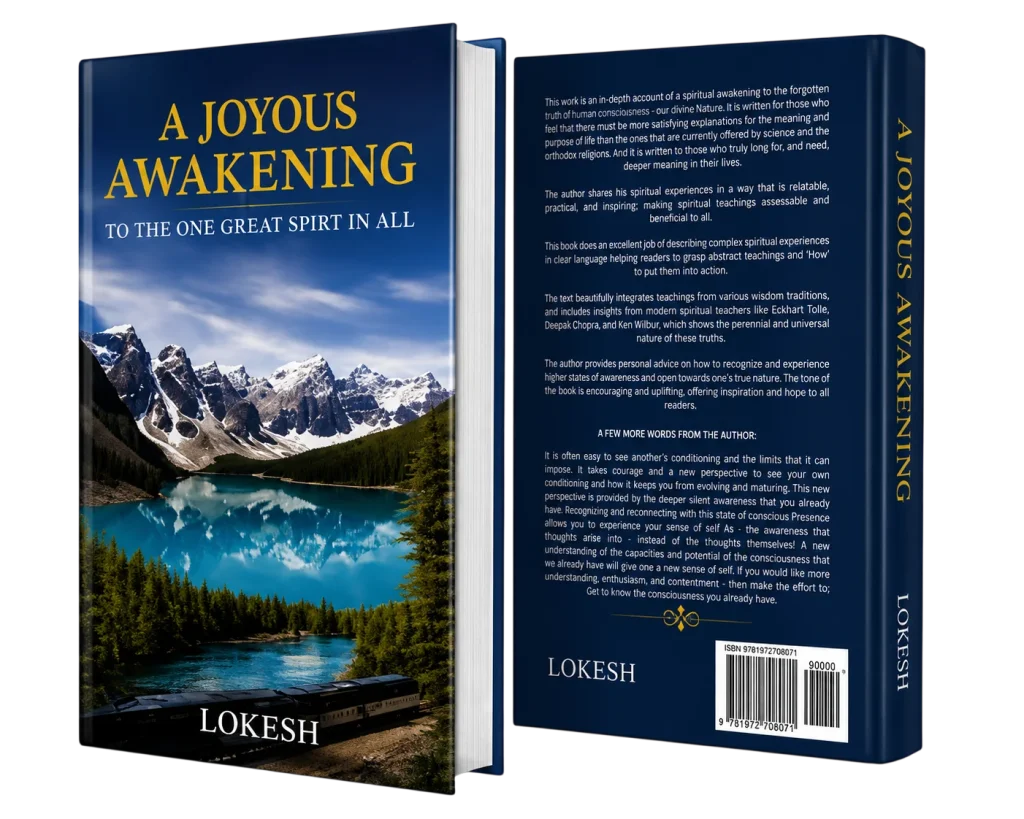

Words for the same deep questions vary throughout many spiritual traditions. Who are we beneath thought? Where does peace begin? Can the divine be known through direct experience?
In A Joyous Awakening, LOKESH uses his spiritual journey to explore these concerns. Along the way, he engages in dialogue between Christian mysticism and Eastern philosophy of meditation, self-examination, and philosophy.
Instead than focusing on a single tradition, the book seeks commonalities. Thus, it is addressed to those who appreciate religion and want a more profound spiritual journey.
For a long time, Christian mysticism has sought truth behind the surface. Rather, it seeks to understand the nature of religion as an inward experience.
LOKESH follows a similar strategy. Truths of the spirit are not concepts for him to commit to memory. Awareness, presence, and introspection instead become the guiding principles of his path.
Thus, a connection with Christian mystics is formed organically. Quietness, submission, prayer, grace, and oneness with God were themes that many authors explored.
In a similar vein, A JOYOUS AWAKENING is an introspective work. It asked readers to notice the mind, ego and deeper awareness behind them.
For those reading Christian mysticism books, this might be a more accessible style.
When Christian Meditation Meets Eastern Philosophy
To a contemporary reader, meditation could seem too Eastern. On the other hand, Christianity also has a long history of introspection and calm.
At this point, the novel starts to really grab my attention. Through his work, LOKESH bridges the gap between Christian meditation and Eastern philosophy.
We are not aiming to eradicate their distinctions. Rather than that, the book seeks to understand, through experience, what these routes might disclose.
Being fully present with one’s internal experiences is a fundamental tenet of Buddhist mindfulness practice. Stillness before the divine is also invited in Christian contemplation.
Thus, a seeker might find solace from incessant mental commotion by following either route. They provide room for a different way of knowing.
The spiritual concepts are therefore still associated with the path that humans take. The Watch as a Meeting Place for Christians and Buddhists.
The novel majorly focus on the difference between thought and awareness.
An idea comes, sticks, and then leaves. But we can see the change.
This sensitivity of observation is often stressed in the East. Mindful prayer increases one’s awareness of one’s thoughts but does not manipulate one’s thoughts.
At heart, Christian mysticism is the practice of quiet reflection before God. The inward movement might have similar appearances even if the terminology varies.
Not that Christianity and Buddhism are identical, but A Joyous Awakening explores this meeting place.
It rather shows how both religions interrogate habitual behaviors. Both provides guide attention towards a deeper spiritual life.
Grace and Practice Belong in the Same Journey
Emphasis on practice, discipline, and awareness is common in eastern pathways. Grace is also an essential part of Christian mysticism.
Both these concepts are still of importance thanks to the author.
The seeker has to watch, to meditate, to question, to be more present. But no one can compel each spiritual awakening either.
A sensation of gift may accompany the arrival of understanding at times. That being said, elegance and effort are not mutually exclusive.
This harmony makes the book seem inviting. The process of spiritual development becomes dynamic, but it is never clinical or clinically improved.
Awakening, according to LOKESH, instead occurs when one pays attention, is humble, has direct experience, and seeks a higher power than one’s ordinary self.
Religious books can become arguments about right and wrong. This novel takes a different path with its plot.
LOKESH expertly explores Eastern philosophy, Christian mysticism, yoga, meditation and Buddhist thought — all without making it a competition.
So readers might be able to keep their curiosity. They acknowledge the similarities but respect the vocabulary of each tradition.
The author’s own life is another theme that recurs throughout the novel. Thus the reader is presented with more than awakened theory.
They opt to follow a seeker who is more interested in exploring awareness, learning through doing and challenging the conventional wisdom.
Because of it, the spiritual connection seems easy. The connection is made by experience, not by forced comparison.
A Spiritual Conversation Worth Entering
A JOYOUS AWAKENING by LOKESH is more than simply blending traditions.
It questions what happens when authentic spiritual paths converge around direct experience.
Christian mysticism concerns itself with prayer, grace and stillness and the quest for divine union. Eastern wisdom is meditation, self inquiry and awareness.
These ideas together make up a larger spiritual conversation.
This may be a thoughtful next step for readers interested in Christian mystics, Christian meditation, and Eastern philosophy.
More importantly, the book does not ask readers to borrow answers of Lokesh. It calls them to look within themselves and to ask deeper questions.
It looks at spiritual awakening, meditation, self-awareness and the search for deeper meaning through various spiritual traditions.
It links inner quietude, elegance, reflection, and spiritual consciousness with the ideas that are often explored by Christian mystics.
Yes. LOKESH explores meditation, mindfulness, self-inquiry, and other ideas associated with Eastern philosophy.
Yes, but it does not treat them as equals. It looks at the common themes of awareness, stillness, and inner growth.
It will be of interest to spiritual seekers interested in Christian mysticism, meditation, consciousness, and wisdom from East and West.